Daily writing prompt
Name an attraction or town close to home that you still haven’t got around to visiting.


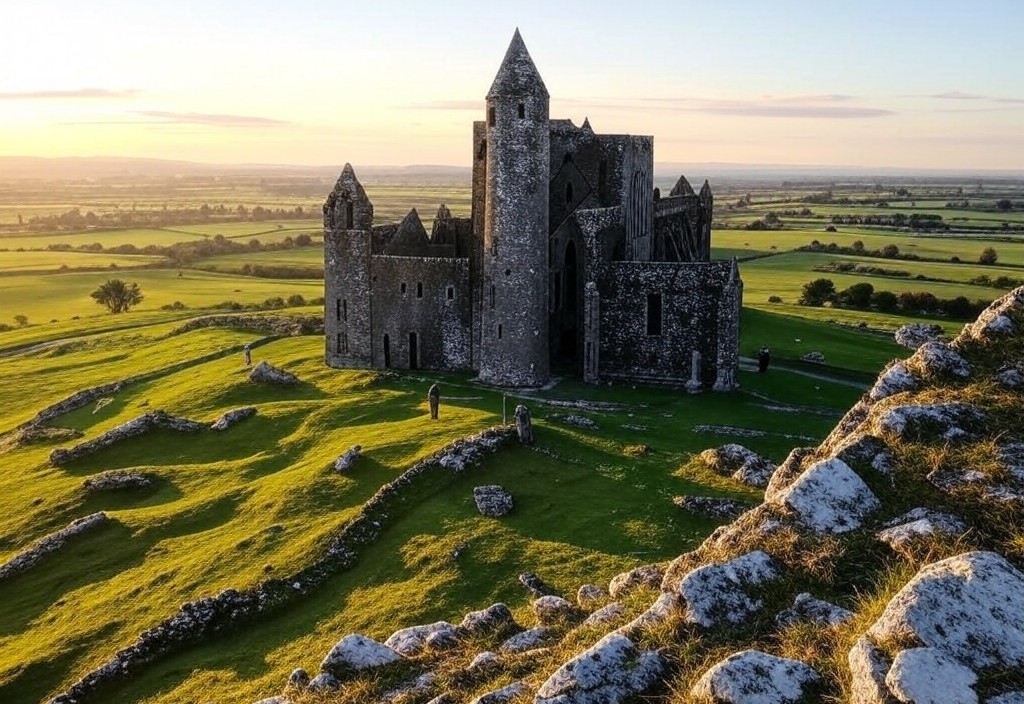
The Rock of Cashel, also known as Cashel of the Kings or St. Patrick’s Rock, is one of Ireland’s most visited archaeological sites, located in County Tipperary. Here’s an overview of its rich history:
Early History
- Mythological Origins: According to legend, the Rock of Cashel was the seat of the Kings of Munster. This started around 370 AD. One famous tale involves St. Patrick converting King Aengus to Christianity here in the 5th century, symbolized by St. Patrick driving his crozier into Aengus’s foot, pinning him to the ground until he converted.
- Medieval Kings: The Rock was the traditional seat of the Kings of Munster. This continued until 1101 when it was handed over to the Church. King Muircheartach Ua Briain (Murtagh O’Brien) is believed to have performed this transfer. He gave the site to the Church as an act of penance.
Ecclesiastical History
- Bishopric: After its donation to the Church, Cashel became a significant ecclesiastical center. The site saw the construction of a cathedral and several chapels, making it one of Ireland’s premier Christian sites.
- St. Cormac’s Chapel: One of the earliest surviving structures on the site, St. Cormac’s Chapel, was built around 1127-1134 by Cormac Mac Carthaigh, King of Munster. It’s one of the finest examples of Romanesque architecture in Ireland, with intricate carvings and frescoes.
- The Cathedral: The construction of the cathedral began in the 13th century, replacing an earlier structure. Much of it was destroyed by fire in 1495. However, the ruins still stand impressively. The chancel arch and parts of the east wall remain.
Later History
- Decline: The importance of Cashel diminished after the Reformation. The seat of the Archbishop of Cashel moved to Thurles in 1752. However, it remained a focal point for religious and cultural activities.
- Restoration Efforts: In the 19th century, significant restoration work was undertaken by Rev. James Butler, Archbishop of Cashel, which included restoring St. Patrick’s Cross.
- 20th Century and Beyond: The site has experienced several conservation projects. Some projects focus on preserving the frescoes in St. Cormac’s Chapel. Today, the Rock of Cashel is a major tourist attraction. It is managed by the Office of Public Works. The site serves as a symbol of Ireland’s rich historical and religious past.
Key Features
- Round Tower: Dating from around 1101, this round tower is one of the best-preserved in Ireland. It stands about 28 meters tall.
- Hall of the Vicars Choral: Built in the 15th century, it housed the clergy who sang in the cathedral’s choir.
- The High Cross: Known as St. Patrick’s Cross, it’s one of the finest examples of Celtic high crosses.
The Rock of Cashel is a testament to Ireland’s medieval past. It is also a monument to its cultural and religious heritage. This site attracts visitors from around the world to explore its storied grounds.