Beauty, Longevity and Ageing Well
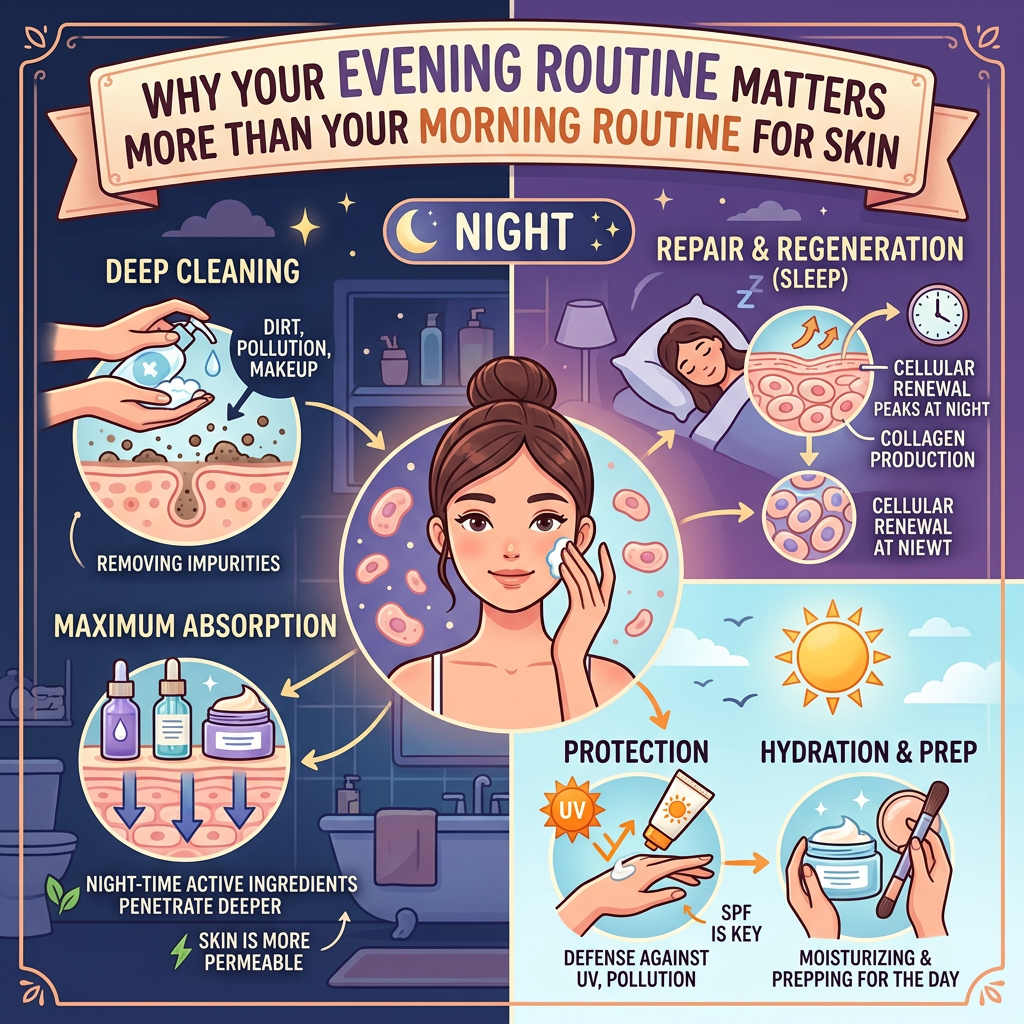
Why Your Evening Routine Matters More Than Your Morning Routine for Skin
Your skin does its most important repair work after dark. Most people spend more time on their morning routine. Here is why that is the wrong way around.
The morning skincare routine has become a cultural centrepiece. Ten-step routines, elaborate serums, layering techniques. And there is nothing wrong with any of it. But the conversation is almost entirely one-sided, because the science is clear on something that marketing rarely emphasises: nighttime is when your skin does its most significant work.
What you put on your skin at night, and the quality of sleep that follows, has a measurably greater impact on skin health and ageing than the equivalent investment in your morning routine. Here is why, and what to do about it.
What your skin is doing while you sleep
Cortisol begins its natural evening decline. The skin’s repair mode is not yet in full activation but this is when topical ingredients applied to the skin begin absorbing into the deeper layers. Any actives applied now will be actively working by midnight.
Cell turnover accelerates significantly in this window. Growth hormone is being released. Blood flow to the skin increases. This is when collagen synthesis is most active and when the skin is most receptive to the ingredients you applied at bedtime. Sleeping during this window is not optional for skin health. It is the mechanism.
This is when the skin loses the most moisture overnight. A good overnight moisturiser applied before sleep significantly reduces this loss. Without it, even well-hydrated skin wakes up measurably drier than it was when you fell asleep.
The repair window closes as cortisol prepares the body for waking. The skin becomes gradually more defensive as morning approaches. This is why morning routines focus more on protection than repair: the biology of protection is a morning job. The biology of repair is a night job.
The evidence-based evening skincare routine
An oil-based cleanser first removes SPF, makeup, and sebum. A water-based cleanser follows to remove residue and environmental pollutants. Sleeping in residual SPF is one of the most common and damaging mistakes in skincare because it prevents the ingredients applied afterward from contacting the skin properly.
Retinoids are used at night for two reasons. First, UV light degrades the molecule and reduces its efficacy. Second, retinoids increase cell turnover which temporarily increases photosensitivity. Applied at night, they can do their repair work during the skin’s peak activity window without interference.
Peptides are short chains of amino acids that signal the skin to produce more collagen and elastin. Unlike retinoids, they cause no irritation and can be used nightly from the beginning. Niacinamide (vitamin B3) at 5 to 10% supports the skin barrier, reduces inflammation, and can be used alongside or instead of peptides.
The purpose of the final step is occlusion: creating a semi-permeable layer that reduces transepidermal water loss during the 2am to 4am peak loss window. Ceramide-rich moisturisers directly replenish the skin barrier lipids that deplete with age. Facial oils high in linoleic acid (rosehip, sea buckthorn) also support barrier function specifically.
“Your evening routine is not the end of your day. For your skin, it is the beginning of the most important eight hours of repair your body performs.”
The other half of the evening routine: sleep hygiene
No topical routine compensates for consistently poor sleep. Growth hormone release, peak cell division, cortisol regulation, every mechanism that makes nighttime repair possible requires actual sleep. Specifically, it requires deep non-REM sleep, which is most abundant in the first half of the night and most easily disrupted by late screens, caffeine after 2pm, and irregular sleep-wake times.
If the evening routine is in place but the sleep is fragmented, the topical ingredients have nowhere near the same effect. The routine and the sleep are one system, not two separate things.
📖Recommended Read
Why We Sleep
Matthew Walker PhD
The essential book on sleep science including the specific mechanisms by which deep sleep drives skin repair, growth hormone release, and cellular regeneration. Changes how you will think about sleep permanently.
View on Amazon →Recommended Read
The Longevity Paradox
Steven R. Gundry MD
Covers the circadian biology of skin and body repair in detail, including how meal timing, light exposure, and sleep interact to determine how effectively the body performs nightly cellular maintenance.
View on Amazon →📚 Full Reading List
All books from this post.
What is one step you are going to add to your evening routine?
Drop a comment. Even the smallest change applied consistently produces real results over months.
Keep reading
Beauty and Longevity
The Collagen Timeline: What Happens to Your Skin Each Decade
Read post →Beauty and Longevity
What Chronic Stress Is Actually Doing to Your Skin
Read post →Food as Medicine
The Anti-Inflammatory Grocery List: What to Buy Every Week
Read post →Psychology
Dark Empathy: When Emotional Intelligence Becomes a Weapon
Read post →Frequently asked questions
Why is an evening skincare routine more important than a morning one?
Because night is when your skin does most of its repair. While you sleep, cell turnover speeds up, blood flow to the skin increases, and the damage from the day gets cleared. A good evening routine works with that repair window, while the morning routine is mostly about protection.
What should an evening skincare routine include?
Keep it simple. Cleanse to remove the day’s makeup, sunscreen, and grime, then treat with something active like a retinoid if your skin tolerates it, and finish with a moisturiser to lock it in. You do not need ten steps. Consistency beats complexity.
Does sleep actually affect your skin?
A lot. Poor sleep raises stress hormones, slows repair, and shows up as dullness, puffiness, and faster ageing. The best evening skincare in the world cannot fully make up for a few hours of missed sleep, which is why sleep hygiene is really part of your routine.
When should you do your evening skincare routine?
A little before bed, not the second you get home, but not so late that you are half asleep. Doing it while you still have energy means you actually do all the steps, and giving actives time to absorb before you hit the pillow helps them work.