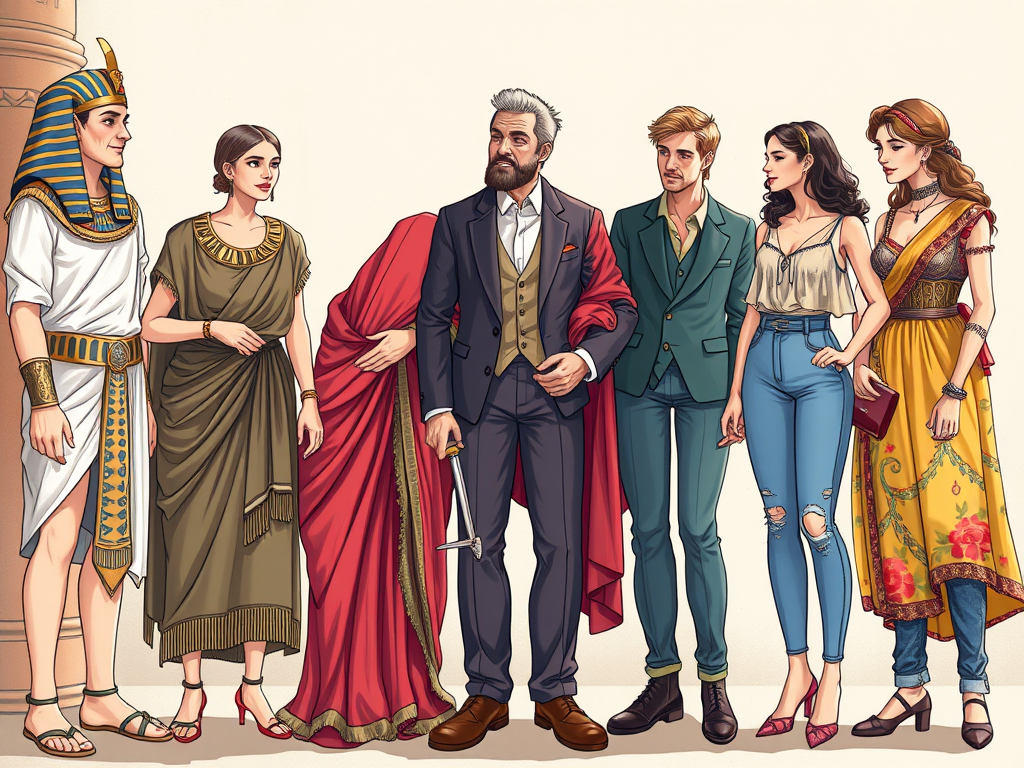
Fashion is not just about clothing; it’s a powerful reflection of culture, technology, and human expression across time. Imagine parading modern fashion trends before historical figures from different epochs. Here’s how six distinct eras would confidently react to today’s fashion:
- Ancient Egypt (c. 3100 BC – 332 BC)
Modern Trend: High Heels, Gold Jewelry
Reaction:
Egyptians, masters of adornment, would undoubtedly value the gold jewelry, recognizing its significance in their tradition. However, they’d be perplexed by high heels, as their sandals were designed for comfort and practicality. They might see today’s fashion as prioritizing individuality over the rich symbolism they cherished.
Quote: “Why elevate the feet when the head should be adorned with crowns?”

2. Ancient Rome (753 BC – 476 AD)
Modern Trend: Tailored Suits, Athleisure
Reaction:
Romans thrived on showcasing their status through clothing. They used fashion to express their social standing. Togas and tunics defined their culture. The ancient Romans liked to display their status through clothing. They used fashion to express their social standing. Togas and tunics defined their culture. They would appreciate tailored suits as a modern evolution of that concept, admiring the sharp, form-fitting style. Athleisure, however, would likely raise eyebrows—where has the decorum gone in our dress?
Quote: “From togas to tracksuits, what has happened to the glory of Rome?”

3, Medieval Times (5th – 15th Century)
Modern Trend: Casual Jeans, Graphic Tees
Reaction:
The Middle Ages valued layers. They also prioritized protection and modesty. Casual jeans and graphic tees would be groundbreaking for their comfort and rebellious in their simplicity. While shocking in their lack of layers, the practicality of these outfits would definitely pique their interest.
Quote: “We covered ourselves in armor; now you shield with denim?”

4. Renaissance (14th – 17th Century)
Modern Trend: Bold Prints, Minimalist Fashion
Reaction:
The Renaissance was an era defined by artistic expression. It was a time rich with creative outpouring. The period was also marked by opulence in fashion. Bold prints would captivate them. They would likely critique minimalist fashion for its lack of the intricate detail they held dear. They’d see modern fashion as a mixture of creative canvas and a missed opportunity for ornate expression.
Quote: “Where are the silks and brocades in this new simplicity?”

5. Victorian Era (1837 – 1901)
Modern Trend: Skinny Jeans, Sheer Fabrics
Reaction:
Victorians epitomized modesty. They valued structure and were enveloped in corsets and long dresses. They consider skinny jeans too revealing, while sheer fabrics would be shocking to their sensibilities. Yet, they’d undoubtedly admire innovations in fabric technology and even envy the freedom of movement these trends represent.
Quote: “Such exposure! Yet, I can’t deny the allure of comfort.”

6. 1920s Roaring Twenties
Modern Trend: Flared Jeans, Crop Tops
Reaction:
The ’20s celebrated liberation in fashion. Flapper dresses and bobbed hair revolutionized societal norms. They would joyously embrace the return of flared jeans and reminisce about the Charleston. Yet, crop tops challenge even their progressive perspectives. Modern fashion would be seen as an extension of their own rebellion against traditional constraints.
Quote: “We freed the legs; you’ve freed the midriff! Let’s dance to this new rhythm.”

Fashion, much like history, is cyclical yet ever-evolving. Each era has indelibly influenced what we wear today, shaping everything from silhouette to symbolism. Some historical figures express horror or amusement at modern trends. Still, many would find a profound connection in the ongoing human pursuit of self-expression through attire. As we look back with admiration, we must also contemplate what future generations will think of our current fashion statements.
How do you think your favorite historical figure would robustly react to today’s fashion? Share your thoughts in the comments!
Are you interested in seeing more exciting comparisons like this? Let me know!