Psychology and Human Behavior
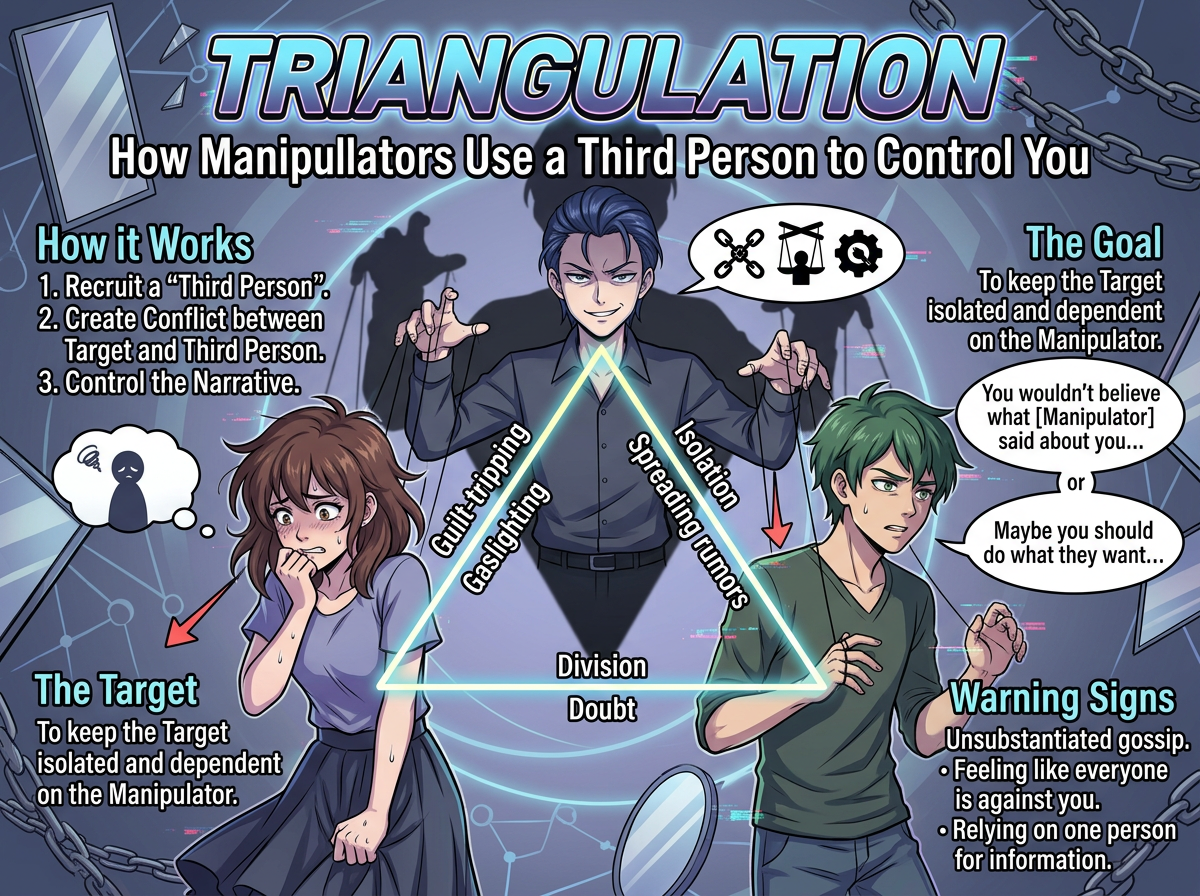
Triangulation
How Manipulators Use a Third Person to Control You
An ex who keeps coming up. A friend who apparently agrees you are the problem. An admirer they mention just often enough. Triangulation turns a two person relationship into a contest you never signed up for.
Most conflict happens between two people. Triangulation quietly adds a third. It might be an ex, a colleague, a parent, a sibling, or someone you have never met who only exists in their stories. Either way, the third person is there to do a job.
That job is to make you feel compared, outnumbered, or replaceable. When you are busy competing with someone else, you are much less likely to question the person who set up the competition.
Why a third person is so effective
Jealousy and insecurity are powerful motivators. If you feel you might lose someone to a rival, you will often try harder, forgive faster, and ask for less. Triangulation manufactures that feeling on demand.
It also spreads the blame. When “everyone” seems to agree with the manipulator, standing your ground starts to feel unreasonable. Triangulation is common in romantic relationships, but it shows up in families and workplaces too, wherever one person benefits from others being divided.
Five signs you are being triangulated
They mention a former partner often, sometimes fondly, sometimes as a warning. Either way, the comparison is the point. You end up measuring yourself against someone who is not there to defend or contradict anything.
Just when you set a boundary or seem less available, they mention someone who is interested in them, or a flirty message they received. The timing is the giveaway. Attention from others is presented as evidence that you should be grateful.
Friends, family, or coworkers are said to share their view of you. You are too sensitive, too demanding, too much. Often you never hear these people say it yourself. The unnamed crowd makes their opinion feel like a verdict.
Instead of talking to you directly, they route things through a third party: a sibling, a mutual friend, a child. You end up negotiating with a messenger, which keeps you off balance and makes direct resolution almost impossible.
They tell you one thing about someone and tell that person something else about you. Over time, the people around them distrust each other, and everyone relies on the manipulator for the real story. Division keeps them at the centre.
You cannot win a competition that was designed to have no finish line. The only winning move is to step out of the triangle.
How to step out of the triangle
Refuse to compete. The moment you start auditioning against the ex, the admirer, or the sibling, the tactic is working. Calmly decline the comparison and bring the conversation back to the two of you.
Go direct whenever you can. If you hear that someone “agrees” with them, check it with that person yourself. If messages come through a third party, ask to talk face to face. Keep a quiet record of what is said, and lean on people outside the triangle who know you well. If the pattern is constant and the relationship feels unsafe, it is worth talking to a professional about your options.
Books that go deeper
🧭Recommended Read
Should I Stay or Should I Go?
Ramani Durvasula
A clinical psychologist explains narcissistic relationship patterns, including jealousy games and comparisons, and how to decide what to do next.
View on Amazon →Recommended Read
Becoming the Narcissist’s Nightmare
Shahida Arabi
A popular guide to the tactics of manipulative partners, triangulation included, with a strong focus on rebuilding your boundaries.
View on Amazon →Recommended Read
Psychopath Free
Jackson MacKenzie
Written for people leaving manipulative relationships. Its sections on comparison and jealousy will feel uncomfortably familiar to anyone who has been triangulated.
View on Amazon →Some links above are affiliate links. If you buy through them we may earn a small commission, at no extra cost to you.
Frequently asked questions
What is triangulation in psychology?
Triangulation is when one person brings a third party into a relationship, directly or indirectly, to create jealousy, competition, or division. The third person might be an ex, a friend, a family member, or an imagined admirer, and is used to make the other person feel insecure or outnumbered.
Why do narcissists use triangulation?
It keeps the other person anxious and working for approval, and it shifts attention away from the manipulator’s own behaviour. When you are busy competing with or doubting a third person, you are less likely to challenge the one who started it.
Is triangulation only in romantic relationships?
No. It is common in families, for example when a parent pits siblings against each other, and in workplaces, where one person relays selective information to keep colleagues divided.
How do I respond to triangulation?
Decline to compete, keep conversations direct, and verify secondhand claims with the people supposedly involved. Staying calm and unreactive removes the reward. If the pattern is persistent or the relationship feels unsafe, talk to a professional or someone you trust.
This article is educational and is not a substitute for professional mental health support. If you are in a controlling or abusive situation, please reach out to a qualified professional or a domestic abuse helpline in your country.