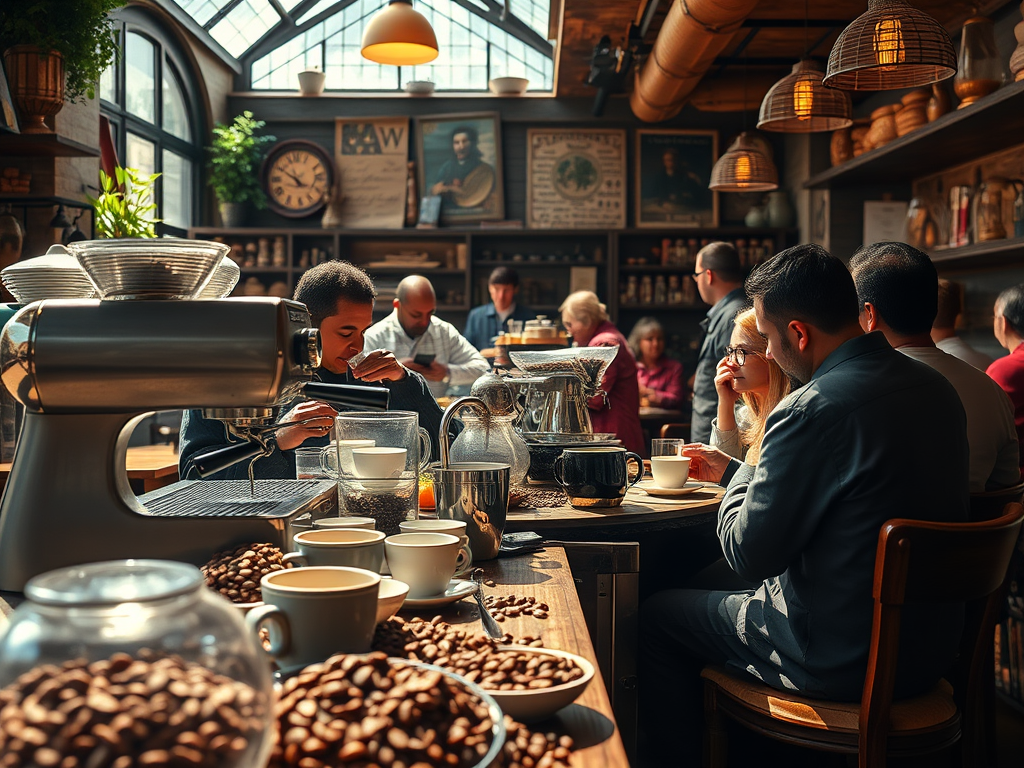
Coffee Culture: A Rich and Intricate History
Coffee culture has a rich and intricate history that spans centuries and continents, influencing social, economic, and political spheres. Here’s an overview:
Origins
Ethiopia
The story of coffee begins in Ethiopia around the 9th century. Legend has it that coffee originated with a goat herder named Kaldi. Kaldi discovered that his goats became more energetic after eating red coffee cherries. From there, coffee spread within Ethiopia, where it was initially consumed in a wine-like form called “qahwa.”
Arabia
By the 15th century, coffee cultivation and trade were well-established in Yemen. They thrived particularly in the port city of Mocha. Here, coffee was roasted, ground, and brewed, much like today. The beverage became integral to daily life, essential to religious practices in Islamic culture. This led to the spread of coffeehouses or “qahveh khaneh.”
Spread Across the World
Ottoman Empire
Coffee reached Istanbul (then Constantinople) by the early 16th century. In Istanbul, coffee houses became central to social life. They were known as places for intellectual discourse, thus earning the nickname “Schools of the Wise.”
Europe
By the mid-17th century, coffee had made its way to Europe. Venice was among the first cities to host coffee houses. These venues soon gained the nickname “penny universities.” For the price of a cup of coffee, one could engage in stimulating conversation and debate.
Colonial Expansion
European colonial powers like the Dutch, British, French, and Spanish began cultivating coffee in their colonies. The Dutch took coffee to Java (Indonesia), which became a major coffee producer. The French introduced coffee to the Caribbean, while the British brought it to India and parts of Africa.
Coffee Culture Development
18th and 19th Century
Coffee houses in Europe were not just places to drink coffee. They were centers for political, artistic, and intellectual activity. In Vienna, the Viennese coffee house culture developed with its unique coffee preparation techniques and pastries.
Industrial Revolution
With the advent of technology like the coffee percolator and later, espresso machines, coffee consumption patterns changed. The espresso machine was invented in the late 19th century. It allowed for quicker service and introduced a new style of coffee consumption, leading to the café culture in Italy.
20th Century
The two World Wars affected coffee culture differently in various regions. Post-war, the U.S. saw a boom in coffee consumption, but it was often of lower quality due to wartime shortages. Yet, the 1960s and 70s saw a resurgence in coffee appreciation, leading to the specialty coffee movement.
Modern Coffee Culture
Specialty Coffee
Beginning in the 1980s, there was a focus on coffee quality and origin. The art of coffee-making gained attention as well. Companies like Starbucks played a role by popularizing gourmet coffee. The concept of third wave coffee emphasizes the quality of the bean, the roast, and the brewing method.
Global Influence
Today, coffee culture varies immensely by country but shares common themes of community, ritual, and craftsmanship. From the Italian espresso to the Turkish coffee ceremony, coffee is cherished around the world. It includes Scandinavian coffee breaks and the Japanese kissaten (traditional coffee shops). Coffee has woven itself into the cultural fabric globally.
Sustainability and Ethics
Modern coffee culture also grapples with issues like fair trade, organic farming, and sustainability. There’s a growing awareness of the impact of coffee production on both the environment and the lives of coffee farmers.
Coffee culture continues to evolve, adapting to new technologies, changing consumer tastes, and global economic trends. Yet, it remains a beloved part of daily life for billions around the world.