The Collagen Timeline: What Happens to Your Skin Each Decade (And What Actually Helps)

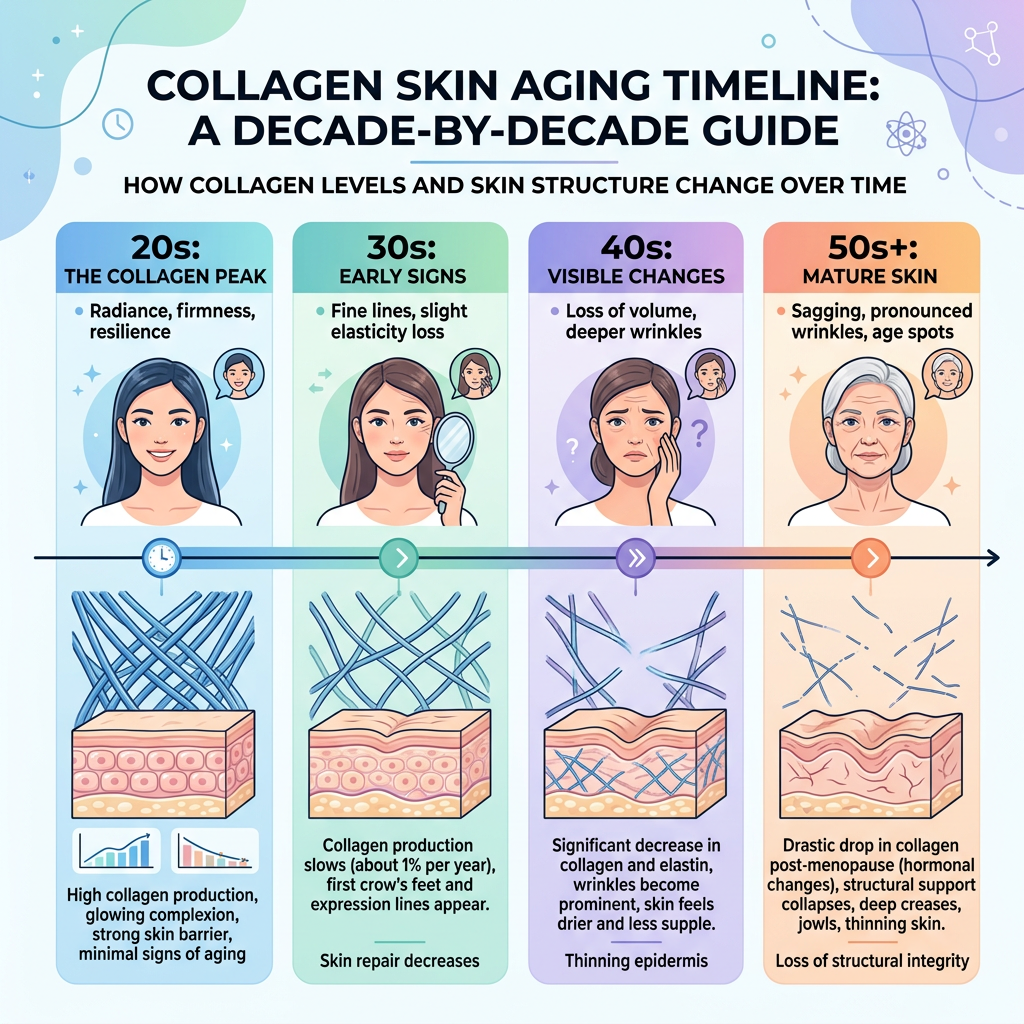
Collagen levels and skin structure changes illustrated for 20s, 30s, 40s, and 50s plus age groups

Beauty, Longevity and Ageing Well

The Collagen Timeline: What Happens to Your Skin Each Decade

Your body starts losing collagen at 25. At menopause it falls off a cliff. Here is what is actually happening, decade by decade, and what the science says helps.

11 min readBeauty and Longevity

Disclosure: atenajos.blog participates in the Amazon Associates Program. As an Amazon Associate I earn from qualifying purchases made through links on this page, at no extra cost to you. Product links point to category searches so you can compare options.

Collagen is the most abundant protein in the human body and the structural foundation of skin firmness, elasticity, and plumpness. It is also, unfortunately, something your body produces progressively less of with every passing year from your mid-twenties onwards.

Understanding exactly what happens at each stage, and which interventions are actually supported by evidence, is far more useful than the marketing language that surrounds most anti-ageing products. Here is the honest timeline.

The baseline science: Type I and Type III collagen are the primary structural collagens in skin. Production peaks in your early twenties and declines at roughly 1 to 1.5% per year from age 25 onward. This rate accelerates sharply at menopause: falling oestrogen directly reduces collagen synthesis, and reviews report that skin may lose as much as 30% of its collagen in the first five years after menopause, followed by around 2% per year after that. By her early sixties, a woman has typically lost a substantial share of the dermal collagen she had at her peak.
Chart showing skin collagen decline across the decades, with an accelerated drop during menopause
Illustrative model based on the ~1%/year decline from age 25 and the up-to-30% post-menopausal drop discussed in this article, not a measurement of any individual.

The decade by decade breakdown

20s
Peak collagen. The foundation is being set.
Collagen production: at or near peak. Decline begins around 25.
What is happening
Collagen levels are at their highest and skin repairs rapidly, so signs of ageing are minimal. But the choices made in this decade compound. Sun damage, smoking, high sugar intake, and poor sleep all accelerate future collagen breakdown long before any visible effect appears.
What actually helps now
SPF 30 or higher every single day. This is the single most evidence-backed anti-ageing intervention available: UV radiation is the primary driver of extrinsic skin ageing and directly degrades collagen fibres. Everything else is secondary to consistent sun protection.
Shop this step
30s
First visible changes. Lifestyle impact becomes visible.
Collagen decline: ~1% per year. Hyaluronic acid production also begins to slow.
What is happening
Fine lines appear around the eyes and mouth, and skin starts to lose some of its bounce. A decade of lifestyle choices becomes visible; sun damage from your twenties shows as uneven pigmentation. Cell turnover slows noticeably compared with ten years earlier.
What actually helps now
Topical retinoids are the most evidence-backed ingredient for stimulating collagen synthesis in the dermis. Start with retinol (OTC) two nights per week and build up. A morning vitamin C serum protects existing collagen from oxidative damage. Together these address the main mechanisms of visible ageing.
40s
Rate of loss accelerates. Structural changes become pronounced.
Collagen decline: accelerating. Perimenopause may begin, further reducing synthesis.
What is happening
Loss of volume becomes visible, particularly around the cheeks and eyes, and skin takes longer to recover. Expression lines become more persistent as the scaffolding that kept skin lifted visibly thins. Perimenopause can bring increased sensitivity and dryness alongside accelerated collagen loss.
What actually helps now
Hydrolysed collagen peptides have the strongest evidence base of any oral supplement for skin. Randomized trials and a 2021 meta-analysis found significant improvements in skin elasticity and hydration versus placebo, typically at 2.5g to 10g daily over 8 to 12 weeks. Topical niacinamide supports the barrier and reduces water loss, and prescription tretinoin (stronger than OTC retinol) is worth discussing with a dermatologist.
“Most anti-ageing marketing sells hope. A small number of interventions sell evidence. Knowing the difference is the whole skill.”
50s
Menopause drives the most rapid period of change.
Fastest decline: up to ~30% of skin collagen lost in the first 5 years post-menopause.
What is happening
The fall in oestrogen at menopause directly reduces collagen synthesis. Skin becomes noticeably thinner, drier, and more prone to sagging. The changes in the first five years post-menopause are among the most rapid in the adult lifespan; wound healing slows and the skin microbiome shifts.
What actually helps now
Keep up the core protocol, peptides, retinoids, daily SPF, barrier care. Red light therapy (630 to 850nm) has a growing evidence base for stimulating fibroblast collagen production, and ceramide-rich moisturisers support the increasingly compromised barrier. On HRT: oestrogen measurably increases skin collagen, but HRT is prescribed for menopausal symptoms and bone health, not for skin, any skin benefit is secondary. Whether it is right for you is a decision to make with your doctor based on your full health picture.
60+
Rate of decline slows. Focus shifts to protection and skin quality.
Production is lower, but the rapid post-menopausal loss has stabilised for most.
What is happening
Skin is thinner and less resilient, healing is slower, and both dermis and epidermis are reduced in thickness. Accumulated sun damage shows as age spots and uneven texture. But the fastest phase of loss has passed for most, and with targeted care meaningful improvements in skin quality remain achievable.
What actually helps now
Consistent collagen peptides, SPF every day without exception, gentle retinoids, and ceramide-focused moisturisation remain the core protocol. Nutrition matters more than ever: vitamin C is essential for collagen synthesis and cannot be stored, and zinc, copper, and manganese are cofactors often depleted in older adults.
📖

Recommended Read

The Menopause Brain

Lisa Mosconi PhD

The leading neuroscientist on menopause explains oestrogen’s role in skin, brain, and body ageing with extraordinary clarity. Essential reading for understanding the hormonal dimension of the collagen timeline.

View on Amazon →
📖

Recommended Read

Why We Sleep

Matthew Walker PhD

Sleep is when collagen synthesis peaks and skin repair occurs. Walker’s book makes the strongest possible case for sleep as the foundational anti-ageing intervention.

View on Amazon →

Which decade are you in right now?

Drop a comment and tell me which intervention from your decade you are going to start with. I read every one.

“The best time to start protecting your collagen was in your twenties. The second best time is right now.”
Leave a comment More longevity posts

References

Key sources behind the claims in this article.

  1. Proksch E, Segger D, Degwert J, Schunck M, Zague V, Oesser S. Oral supplementation of specific collagen peptides has beneficial effects on human skin physiology: a double-blind, placebo-controlled study. Skin Pharmacol Physiol. 2014;27(1):47 to 55.
  2. Proksch E, Schunck M, Zague V, Segger D, Degwert J, Oesser S. Oral intake of specific bioactive collagen peptides reduces skin wrinkles and increases dermal matrix synthesis. Skin Pharmacol Physiol. 2014;27(3):113 to 119.
  3. de Miranda RB, Weimer P, Rossi RC. Effects of hydrolyzed collagen supplementation on skin ageing: a systematic review and meta-analysis. Int J Dermatol. 2021;60(12):1449 to 1461.
  4. Viscomi B, et al. Managing menopausal skin changes: a narrative review of skin quality changes and the actual role of hormone replacement therapy in improvement. J Cosmet Dermatol. 2025.
  5. Brincat MP, et al. Skin collagen changes related to age and hormone replacement therapy. Reviews in Climacteric / Maturitas. (Foundational research on the ~30% post-menopausal collagen decline.)

Medical disclaimer: This article is for general educational purposes only and is not medical advice. Individual needs vary. Consult a qualified healthcare professional or dermatologist before starting supplements or prescription treatments (including retinoids or hormone replacement therapy), or making changes to your skincare, diet, or health routine.

CollagenSkin AgeingBeauty ScienceLongevityMenopauseAnti AgeingRetinolSPF

Frequently asked questions

When does your skin actually start losing collagen?

Earlier than most people think. Your body starts making a little less collagen from your mid twenties, and the drop speeds up through your thirties and forties. By the time you notice thinner, less bouncy skin, the slowdown has usually been going on quietly for years.

Can you really rebuild collagen, or only slow the loss?

A bit of both. You cannot rub collagen straight back into your face, but you can push your body to make more of its own. Steady protein and vitamin C, daily sunscreen, a retinoid, and not smoking all help. The realistic goal is to slow the loss and nudge production up, not to turn the clock all the way back.

Do collagen supplements actually work?

The evidence is mixed but leaning positive for skin elasticity and hydration, especially with hydrolysed collagen peptides taken daily for a few months. They are not magic, and a good diet does a lot of the same work. If you try one, give it real time before you decide.

What is the single most important thing for keeping collagen?

Sun protection. Nothing breaks down collagen faster than daily UV exposure. Wearing sunscreen every day does more for your skin over a lifetime than any serum or supplement you can buy.

Keep reading


Discover more from atenajos

Subscribe to get the latest posts sent to your email.

Watch on YouTube
, , , , , ,

Discover more from atenajos

Subscribe now to keep reading and get access to the full archive.

Continue reading

Discover more from atenajos

Subscribe now to keep reading and get access to the full archive.

Continue reading