Psychology and Human Behavior
Trauma Bonding: Why Leaving Feels Impossible
The person hurting you and the person comforting you are the same person. That is not a character flaw in you. It is a neurochemical trap, and traps can be understood, and escaped.
If you have ever watched someone stay in a relationship that is clearly hurting them, or found yourself unable to leave one, you have probably heard the same unhelpful explanations. They love too much. They have low self-esteem. They must secretly like it.
None of that is true. Trauma bonding is not weakness, and it is not a taste for pain. It is a specific, predictable physiological response to a specific pattern of treatment. Once you understand the mechanism, the thing that felt like a personal failing turns out to be one of the most well-documented processes in the psychology of abuse.
The term “trauma bond” was popularised by Patrick Carnes, who described the way people form powerful attachments to those who intermittently harm and reward them. It is the glue in relationships with narcissists, in cults, in coercive control, and in ordinary relationships that have quietly tipped into abuse. And it explains the single most misunderstood thing about these situations: why leaving feels not just hard, but physically impossible.
The five stages of the cycle
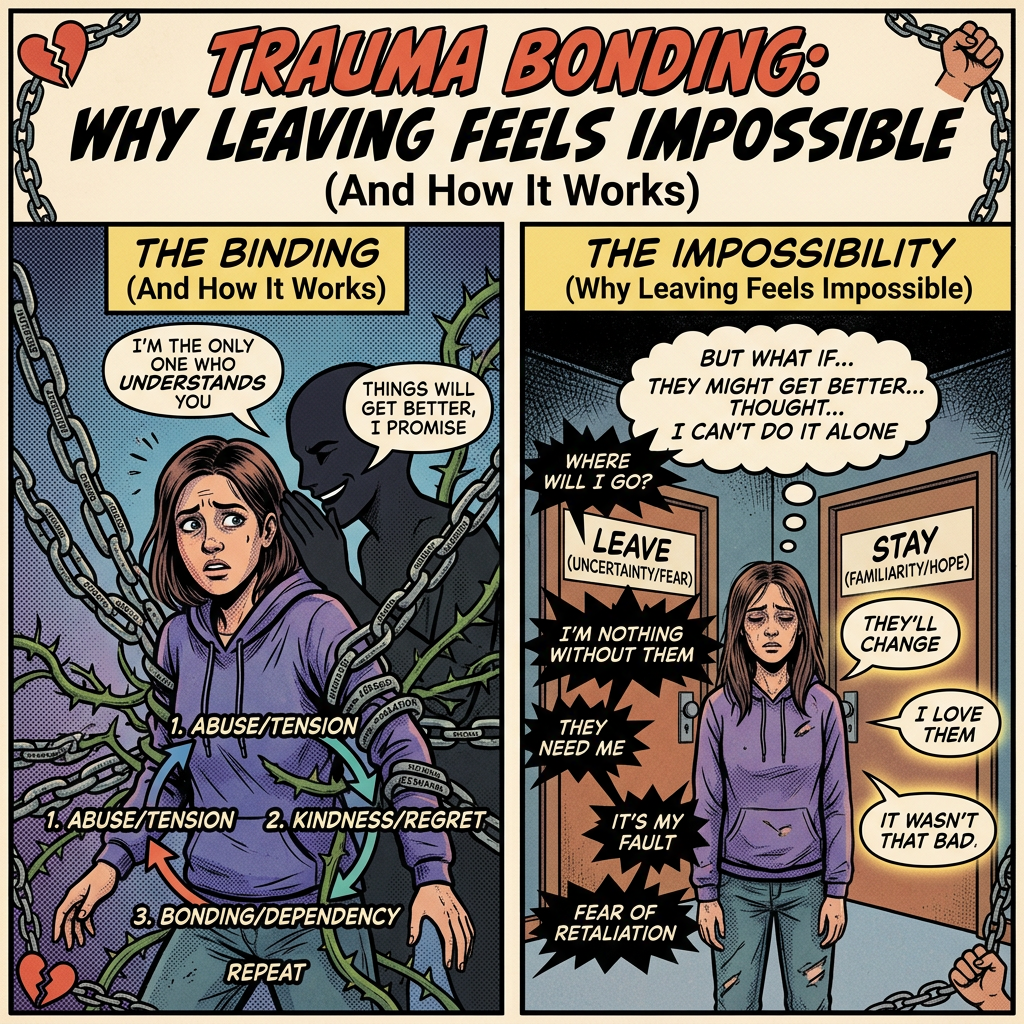
Trauma bonds are not static. They run in a loop, and the loop is what makes them so disorienting from the inside. You are never dealing with one consistent person, you are dealing with a rotation.
The relationship begins with intense attention, admiration, and a sense of being uniquely understood. This is not a trick you should have seen through, it is a genuinely powerful experience, and it sets the reference point. Everything that follows is measured against this early high, which is exactly why it is so hard to give up on.
Criticism, withdrawal, or unpredictability creeps in. The warmth becomes conditional. You start monitoring their moods and adjusting your behaviour to avoid the next drop. Crucially, you begin to believe the loss of warmth is your fault, that if you can just get it right, the idealisation phase will return.
An argument, an act of cruelty, a betrayal, a rage. This is the sharpest point of the cycle and, paradoxically, the moment that deepens the bond most, because it is followed by…
Apology, explanation, tenderness, promises. Sometimes tears. The warmth returns, and because it arrives right after the worst moment, the relief is enormous. Your nervous system, flooded with stress and then sudden relief, reads this as intense connection. This is the reward that trains the bond.
A period of peace where things feel almost normal. Hope is restored. You tell yourself the incident was an aberration. And then, unpredictably, the tension begins to build again, and the loop restarts, each turn tightening the bond a little more.
“A trauma bond is not love that has gone wrong. It is a survival response that has been hijacked by someone who benefits from your loyalty.”
Why leaving feels impossible
People on the outside ask, “Why don’t they just leave?” It is the wrong question, because it assumes leaving is a simple decision rather than a fight against your own biochemistry. Several forces are working at once.
Neurochemistry. The cycle floods the body with cortisol and adrenaline during the bad phases and dopamine and oxytocin during reconciliation. Over time the brain associates the person with the whole rollercoaster, and the relief of reconciliation becomes something the nervous system actively craves, a pattern that looks, on brain imaging, remarkably like addiction.
Cognitive dissonance. Holding two truths at once, “this person hurts me” and “this person is the love of my life”, is intolerable, so the mind resolves the tension by minimising the harm and magnifying the good moments. The worse the treatment, the harder the mind works to justify staying.
Intermittent hope. Because the good phases are real, leaving does not feel like escaping a bad thing, it feels like giving up on a good thing that keeps almost coming back. That is the cruelty of intermittent reinforcement: it keeps hope permanently alive.
Signs you may be in a trauma bond
- You make excuses for behaviour you would never accept from a friend’s partner.
- The good moments feel disproportionately intense, and you live for them.
- You feel unable to leave even though you can clearly describe the harm.
- You have withdrawn from friends and family, or hide the relationship’s reality from them.
- You believe you can “fix” it if you just become good enough, calm enough, or patient enough.
- The thought of the relationship ending produces something closer to withdrawal than relief.
How the bond breaks
Breaking a trauma bond is not a decision you make once. It is a process of retraining a nervous system, and these are the levers that matter most.
- ⏺Create distance, as much as is safe. The bond is maintained by contact and by the cycle. No contact, or the most structured minimal contact your situation allows, is what finally lets the nervous system stop chasing the next reconciliation. If safety is a concern, plan this with a professional.
- ✎Write the cycle down. Keep a private, factual log of incidents and reconciliations. When the idealisation memory pulls you back, the record interrupts the mind’s tendency to minimise. You are giving your future self evidence.
- 👥Rebuild outside connection. Isolation is the bond’s best friend. Reconnecting with even one or two people who knew you before restores an external reference point for what normal treatment feels like.
- 🌱Work with a trauma-informed therapist. This is the pattern therapy exists for. A good therapist does not tell you to leave, they help your nervous system tolerate the withdrawal and rebuild a sense of self that does not depend on the cycle.
- ⏳Expect the pull-back, and be patient. Missing them, doubting yourself, romanticising the good times, these are withdrawal symptoms, not signs you made a mistake. They fade. The bond was built over months or years; unbuilding it takes time too.
The most important reframe is this: the strength of the bond is not a measure of how much you loved them, or of how good the relationship really was. It is a measure of how effectively the cycle exploited a normal human wiring for attachment. Understanding that is not just comforting, it is the first crack in the loop.
📖Recommended Read
The Betrayal Bond
Patrick Carnes PhD
The book that named the phenomenon. Carnes explains how exploitative bonds form and, crucially, gives a structured framework for breaking free of them. The definitive starting point if this post described your situation.
View on Amazon →Recommended Read
Why Does He Do That?
Lundy Bancroft
Written by a counsellor who spent years working with abusive men, this is the clearest available guide to the mindset behind controlling behaviour. It dismantles the idea that the abuse is your fault, which is exactly the belief a trauma bond runs on.
View on Amazon →Which stage of the cycle do you recognise?
Naming it is the first step out of it. If any part of this felt familiar, that recognition is worth more than you think right now.
Keep reading
Psychology
The Fawn Response: Why Some People Appease Instead of Fight or Flee
Read post →Psychology
Dark Empathy: When Emotional Intelligence Becomes a Weapon
Read post →Psychology
How Manipulators Use Your Own Kindness Against You
Read post →Money and Mind
Financial Abuse: The Form of Control Nobody Talks About Enough
Read post →Frequently asked questions
What is a trauma bond?
A trauma bond is the powerful attachment that forms with someone who hurts you, built by repeated cycles of pain followed by affection. The relief of the good moments after the bad ones is what keeps pulling you back, which is why it feels so hard to leave.
Why does leaving a trauma bond feel impossible?
Because the bond is chemical as much as emotional. The highs and lows train your brain to chase the next reconciliation, a bit like a slot machine that pays out just often enough to keep you playing. Struggling to leave is not weakness, it is your nervous system doing exactly what it was conditioned to do.
What are the stages of a trauma bond?
It tends to run in a cycle: idealisation and love bombing, then tension building, then an incident or blow-up, then reconciliation and calm, and back to the start. Each turn of the wheel deepens the attachment, because the calm feels like proof it can work.
How do you break a trauma bond?
Distance is what actually breaks it, because the cycle needs contact to survive. That means no contact or the least contact you can manage, support from people outside the relationship, and often a therapist who understands abuse. Expect to grieve, even the parts that hurt you.